Healthcare facility operations, compliant and online
One platform for the systems a hospital cannot run without: emergency generators, transfer switches, medical refrigeration, chillers, air handlers, and the electrical distribution behind them. The compliance record builds itself while the facilities team runs the building.
Automated compliance trackingCritical equipment uptime12-15% energy savings15-minute faster response
The status quo
Healthcare facility teams are stretched thin
Between regulatory pressure, aging infrastructure, and 24/7 uptime requirements, facility teams are forced to react to problems instead of preventing them, all while patient care depends on every system staying online.
01
01 / Compliance pain
Generator test documentation lives on clipboards
Joint Commission surveyors expect a record of every emergency generator load test: the load held, how long it was held, and how fast each transfer switch picked up. When that record is a clipboard in the plant room and a spreadsheet in the office, survey week means reconstructing months of tests by hand.
02
02 / Operational pain
Critical equipment fails between rounds
A pharmacy vaccine refrigerator drifting warm on a Friday night, a chiller tripping over a holiday weekend, an ATS that never retransferred after the last utility blip. On manual rounds, each of these is discovered hours later, after the inventory loss or the hot floor complaint has already happened.
03
03 / Energy pain
A 24/7 building with no energy visibility
Hospitals never close, so chillers, air handlers, and sterilizers run around the clock whether the schedule makes sense or not. Without metering granular enough to separate waste from unavoidable load, and to catch utility billing errors, the energy budget only ever moves in one direction.
04
04 / Response pain
Alarms stop at the panel
The BMS annunciates to a workstation in the plant office. If the operator is on a round, at another campus, or off shift, the alarm waits. By the time someone sees it, a single-point failure has cascaded into disrupted clinical workflows and a safety report.
05
05 / Reporting pain
Reports take hours to produce
Generator runtime for the EPA, load-test evidence for the surveyor, energy numbers for the sustainability committee. The data exists across the BMS, the generator controllers, and the meters, but pulling it into one report eats engineering time that should go to patient-facing priorities.
Use case
One platform for compliance, uptime, and energy
ControlCom Connect unifies the systems that keep a hospital running, so facility teams can prove compliance, prevent downtime, and cut energy costs without adding headcount.
ControlCom Connect reads the equipment a hospital already owns. Pre-built connectors for Modbus TCP/RTU, BACnet IP/MSTP, OPC-UA, and MQTT bring the BMS, generator controllers, transfer switches, chillers, air handlers, and power meters into one platform without replacing any of them. The generator fleet gets the deepest treatment: every run is detected automatically from the breaker closing or an ATS run request, and the platform writes a compliance report per run, recording whether the unit held its minimum load for the required duration and how each transfer switch performed against its transfer-time requirement. Hospitals that carry sustained load on their own generation pair this with prime power monitoring for fuel and runtime analytics.
The same continuous record covers the cold side of the building. Pharmacy vaccine refrigerators, blood bank units, and lab freezers are monitored around the clock with per-asset thresholds, and excursion alerts reach on-call phones by SMS and push within seconds instead of at the next round. Regulated storage that has to survive an inspection, from CDC VFC vaccine documentation to pharmacy compounding suites, is covered in depth under cold chain monitoring. Together with generator testing logs and emissions runtime, this is the evidence base behind regulatory compliance: audit-ready PDFs generated from live data rather than reconstructed from binders.
Energy runs on the same data set. Continuous metering across chillers, air handling, and the electrical distribution separates schedule waste and billing errors from unavoidable clinical load, which is where the typical 12-15% reduction in energy costs comes from. From single hospitals to multi-site networks, each facility keeps local control while leadership sees the fleet, and facility managers get one view across BMS, generators, refrigeration, and life-safety systems instead of five.
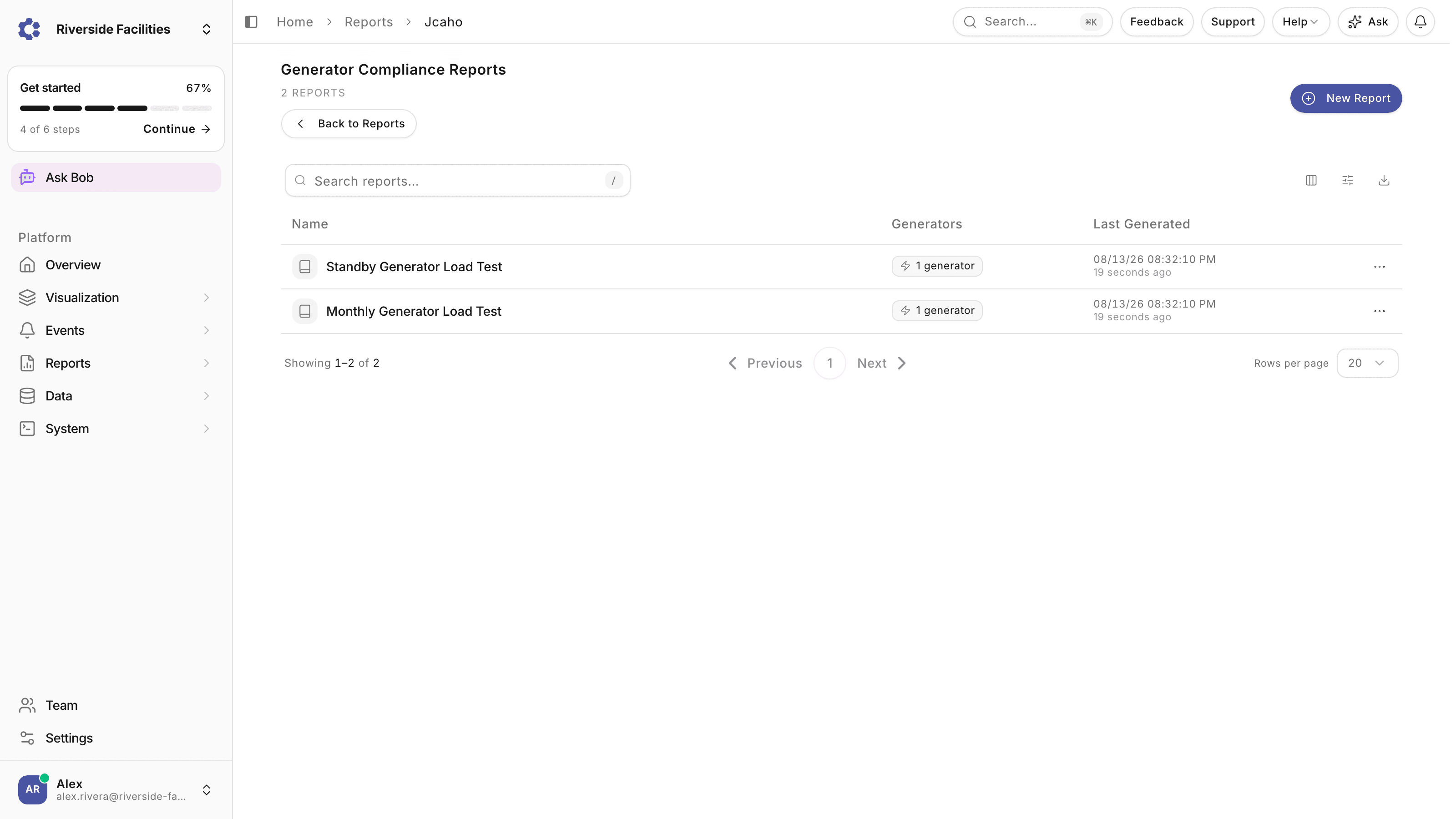
One compliance report per detected generator run, with load held and duration.
Continuous monitoring of life-safety and critical systems
Automated generator testing logs and emissions tracking
Real-time energy benchmarking across facilities
Audit-ready reports generated on demand
What's in the platform
Features built for healthcare facilities
Purpose-built tools to keep critical infrastructure online, compliant, and efficient.
01
Generator compliance tracking
Every generator run is detected and documented automatically: load held, duration, transfer-switch timing, pass or incomplete with the reason. Runtime splits into emergency and non-emergency hours for EPA reporting, with an override workflow for runs recorded as routine that were in fact outages.
02
Energy optimization
Continuous metering across chillers, air handlers, and the electrical distribution, with utility-bill ingestion and load-factor reporting. Separates schedule waste and billing errors from unavoidable clinical load in a building that never closes.
03
Critical equipment monitoring
Generators, ATS, switchgear, medical refrigeration, chillers, and air handling in one asset hierarchy, with runtime, cycle counts, and trend history per asset. Slow drifts, a compressor degrading or a coolant temperature creeping, surface before they become failures.
Per-asset thresholds and severity tiers route SMS, push, and email by alarm group, so the on-call engineer is paged for critical power while mechanical warnings go to email. Acknowledgement is recorded with user and timestamp. Teams average 15-minute faster response to critical events.
05
Automated reports
Scheduled compliance reports for regulatory requirements that save 8+ hours monthly on report generation. Any dashboard exports as a PDF for any historical date range, and generator reports save to PDF for the surveyor.
Deep insights into energy usage patterns across facilities, typically 12-15% reduction in energy costs through optimization or billing error detection. Benchmark buildings against each other across the network.
Common questions from facility, compliance, and operations leaders.
Yes, and generator testing is the strongest example. Each emergency generator is registered as an asset, every run is detected automatically from the generator breaker closing or an ATS run request, and the platform writes one compliance report per run: whether the unit held its configured minimum load (30 percent by default, so a 750 kW generator has to hold 225 kW) for 30 continuous minutes, how long each transfer switch took against its required transfer time, and the specific reason when a test comes back incomplete. A separate runtime report splits engine hours into emergency and non-emergency time for EPA reporting, with an override workflow for runs logged as routine that were actually outages. Every report saves to PDF for the surveyor, reports regenerate from stored readings if data changes, and tests performed on Tuesday appear without anyone opening the page.
It works with what is already installed, and the BMS stays. ControlCom Connect reads building systems over BACnet IP/MSTP, generator controllers and switchgear over Modbus TCP/RTU, and newer equipment over OPC-UA and MQTT, alongside 4-20mA, RTD, thermocouple, and dry-contact points for refrigeration probes and status inputs. That covers the typical hospital mix: a BMS from one vendor, generator controllers from another, transfer switches from a third, and meters older than all of them. The platform sits on top as the monitoring, alerting, and reporting layer, so the local control logic in the BMS and the generator controllers keeps running exactly as before. There is no rip-and-replace project, and no per-tag licensing, so extending coverage from the central plant to pharmacy refrigeration and IT closets is configuration within the device and data allotment of your plan rather than a per-tag license purchase.
Most single sites are live within weeks. The edge agent installs on a small box on the facility network, makes outbound-only connections so no inbound firewall holes are opened, and pre-built protocol connectors start collecting from the BMS, generators, and meters in days. Multi-site healthcare networks then roll out facility by facility: the first hospital establishes the templates, and each subsequent site inherits the same asset structure, alarm thresholds, escalation paths, and report configurations rather than starting from scratch. The practical sequencing decision is which systems to onboard first; most networks start with emergency power and medical refrigeration because those carry the compliance exposure, then extend to chillers, air handling, and energy metering on the same platform. Each facility keeps its own view and its own alarm routing while leadership gets the roll-up across the network.
Healthcare customers typically see a 12-15% reduction in energy costs, and it comes from three places. First, scheduling: a hospital never closes, but not every air handler, pump, and sterilizer needs to run at full output around the clock, and continuous metering shows exactly which loads are running outside the hours that clinical operations require. Second, equipment: a chiller operating off its efficiency curve or a compressor degrading burns money for months before it fails, and trend data catches the drift early. Third, billing: utility-bill ingestion and load-factor reporting surface metering and billing errors that would otherwise be paid without question. None of this requires new equipment; the savings come from making the consumption of existing systems visible at a granularity the monthly utility bill cannot provide, then benchmarking facilities against each other across the network.
Facility managers, plant operations engineers, compliance officers, and energy or sustainability leads, each with a different slice of the same data. The plant engineer watches live dashboards for the central plant and gets paged on critical power alarms. The facility manager sees uptime, open alarms, and who is working on what across the building. The compliance officer pulls generator test reports and refrigeration logs when the surveyor asks, without involving engineering. The sustainability lead tracks energy per facility against the network benchmark. Role-based access keeps each of these views scoped: alarm subscriptions are managed per person and per channel, so the on-call engineer receives SMS for critical events while a director gets a daily email summary. Every account signs in with MFA or a magic link, and audit logging records who acknowledged which alarm and when.
Through alarm groups that route by response rather than by equipment. Each alarm belongs to a group, each group enables the channels it needs (SMS, push notification, email), and each person subscribes per channel, so a Critical Power group can page the on-call engineer by SMS while a Mechanical Systems group only sends email. Critical alarms reach phones within seconds of the threshold breach, and thresholds are evaluated on the edge agent at the facility, so alerting does not depend on the internet connection being up at that moment. Acknowledgement happens from the native iOS or Android app with the user and timestamp recorded, which is how the team sees what is already covered and how the audit trail shows who responded. The result healthcare teams measure: an average 15-minute faster response to critical events than panel-based annunciation.
Get started
Ready to optimize your healthcare facility?
Start with one facility and the systems that carry the compliance exposure: emergency power and medical refrigeration. We connect the equipment you already own, configure the alarms and reports your team needs, and you evaluate the platform on real data. Book a demo to scope it.