Every generator, fuel tank, and transfer switch in the fleet reporting into one platform. Woodward, ComAp, DEIF, and OEM controllers read over Modbus, CAN, and SNMP, with runtime split for the regulator and fuel burn tracked per unit.
Prime power operations run blind on fuel, uptime, and compliance
Most prime power facilities still rely on manual rounds, paper logs, and reactive maintenance. The result is wasted fuel, unplanned downtime, and compliance gaps that put permits and contracts at risk.
01
01 / Fuel waste pain
Generators run outside their efficient band
A multi-unit site carrying variable load without intelligent balancing ends up with units lightly loaded for hours, burning more fuel per kWh and wet stacking diesel engines that were never meant to idle. The per-kWh cost creeps up every month, and nobody can see which unit is driving it.
02
02 / Downtime pain
Failures hit before anyone sees them coming
Coolant temperature drifting a degree a week, oil pressure sagging at load, injector irregularities showing up as uneven exhaust temperatures. On paper logs, each of these is invisible until the unit trips, and an unplanned outage cascades into SLA penalties and emergency service calls.
03
03 / Compliance pain
Emissions reporting eats engineering hours
Runtime hours, fuel logs, and emissions data live on the controller, in the fuel vendor portal, and on clipboards. Stitching them into regulator-ready reports consumes more than a day a month per facility, and a single missed data point can trigger a violation.
04
04 / Visibility pain
No single view across the fleet
Each controller brand ships its own software, the fuel system has its own gauges, and the ATS panels report to nobody. There is no unified picture of fleet health, fuel inventory, or which units are approaching a service interval until someone drives out and looks.
05
05 / Cost pain
Operating costs creep without anyone noticing
Small inefficiencies (a unit running rich, a filter past its service interval, a load curve that favors the wrong generator) compound into six-figure fuel and maintenance overruns each year.
Use case
A connected layer for every generator, fuel tank, and switchgear cabinet
Turn your prime power fleet into a monitored, optimized, audit-ready operation.
ControlCom Connect reads the generator controllers already on the units, Woodward, ComAp, DEIF, and OEM control systems, over Modbus, CAN, and SNMP, alongside fuel level sensors on 4-20mA, ATS panels, and emissions monitors. Each generator is registered as an asset with its own telemetry history, so engine hours, coolant temperature, oil pressure, frequency, and load accumulate per unit, and the fleet view shows which generators are running, which are due for service, and how much fuel is on site. Remote and distributed sites run the same store-and-forward edge architecture as oil and gas field monitoring: data buffers locally through cellular outages and alarms keep evaluating at the edge.
Runtime documentation builds itself. Runs are detected from the engine-hours reading, so every start lands in the runtime report with its start time, end time, and duration, split into emergency and non-emergency hours the way EPA reporting asks for, with an override workflow for runs recorded as routine that were in fact outages. Facilities with standby obligations get automatic load-test documentation: whether the unit held its minimum load for the required 30 continuous minutes and how each transfer switch performed against its transfer-time requirement. That evidence trail is the core of regulatory compliance for a generation site, and it is the same generator reporting that hospitals use for their surveyors.
The same telemetry runs the efficiency program. Load and fuel burn per unit show which generators are operating outside their efficient band, the lever behind a typical 10-15% fuel reduction from smarter load distribution, and trend-based alerts on coolant, oil, and injector health surface developing failures days to weeks early, which is where the up to 40% cut in unplanned outages comes from. Sites that pair generation with critical load, from data centers running standby fleets to microgrids, track energy production and consumption on the same dashboard the operators already watch.
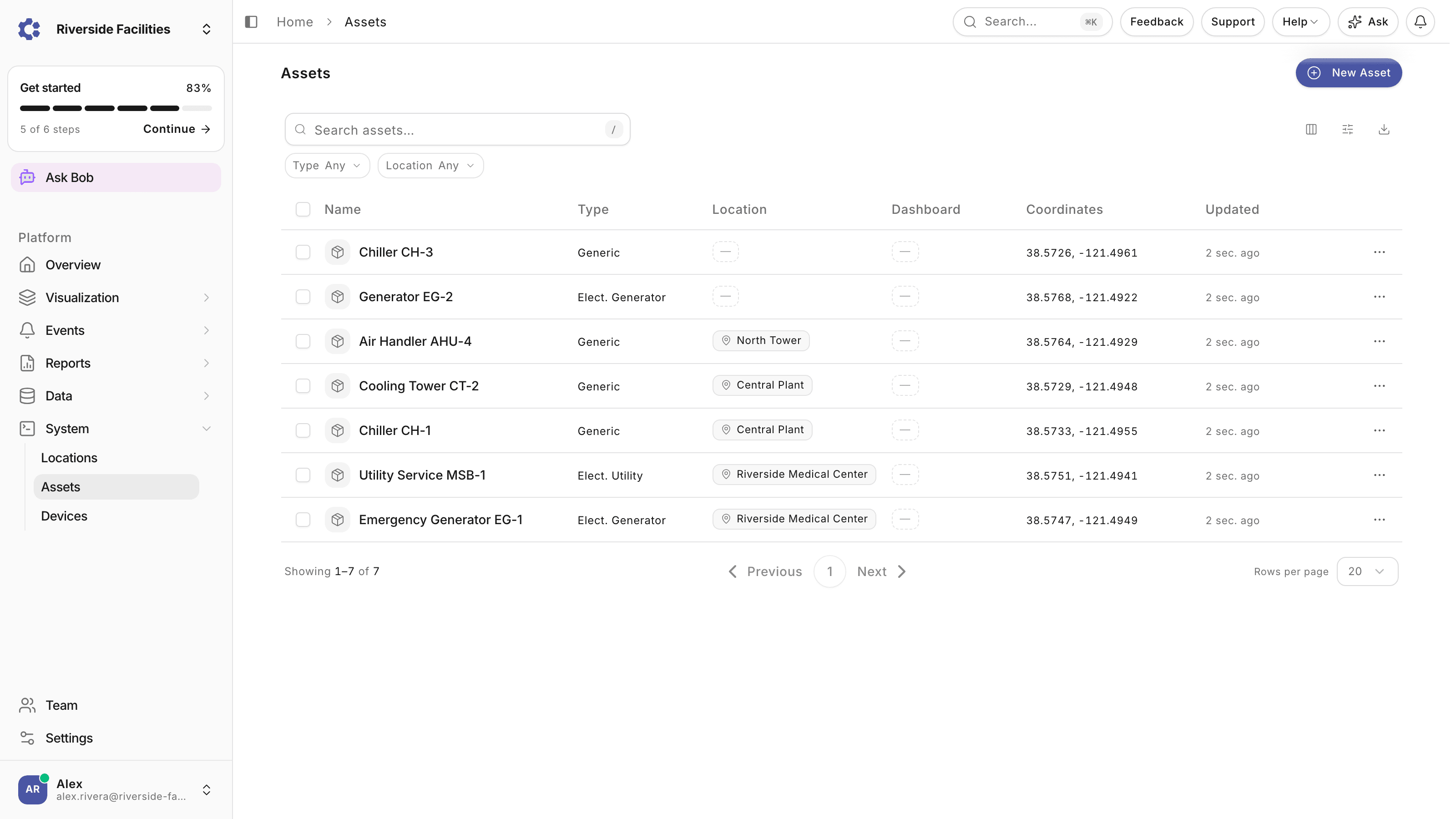
The generator fleet as an asset list, with status and last reading per unit.
Live telemetry from every generator and fuel tank
Automated load balancing across multi-unit sites
Anomaly alerts on coolant temperature and oil pressure
One-click emissions and runtime reports
What's in the platform
Features built for prime power facilities
Everything you need to run a high-availability, high-efficiency generation site.
01
Performance monitoring
Live load, frequency, coolant temperature, oil pressure, and engine hours per unit, read from Woodward, ComAp, DEIF, and OEM controllers over Modbus, CAN, and SNMP. Every reading is kept, so this month is always comparable against last.
Fuel burn tracked per unit against load carried, with tank levels from the fuel system in the same view. The units running rich, the light-load hours that wet stack diesels, and the deliveries that do not match consumption all become visible.
03
Emissions compliance
Every run is detected from engine hours and logged with start, end, and duration, split into emergency and non-emergency time for EPA reporting. Overrides record the outages that were logged as routine, and reports save to PDF for the regulator.
04
Load management
Intelligent load balancing across multiple generators keeps each unit in its efficient operating band, delivering a typical 10-15% reduction in fuel consumption across multi-unit sites.
05
Anomaly detection per unit
Anomaly detection on coolant temperature, oil pressure, and load flags a unit drifting from its own baseline early enough to schedule service in a planned window instead of answering the emergency call.
Generate compliance reports for regulatory requirements automatically, saving 12+ hours per month per facility. Any dashboard exports as a PDF for any historical date range, and scheduled delivery sends the package without anyone remembering to run it.
Common questions from operators evaluating ControlCom Connect.
The platform integrates with major generator controller families over Modbus, CAN, and SNMP, including Woodward, ComAp, DEIF, and most OEM-provided control systems, and custom protocol support is available for legacy units. In practice, the controller is only part of the picture: the same edge agent also reads fuel level sensors over 4-20mA, ATS panels through their auxiliary contacts and Modbus registers, power meters, and emissions monitors, so the whole generation site lands in one asset hierarchy rather than just the engines. Mixed fleets are normal and expected; a site running a ComAp-controlled unit next to two OEM-panel units feeds the same dashboards and the same alarm engine, and the fleet view does not care which brand of controller produced the reading. If a controller on your site speaks none of the supported protocols, raise it during the demo and we will tell you plainly whether it can be read.
Most multi-unit prime power sites see a 10-15% reduction in fuel consumption once load balancing is optimized across the fleet, and the mechanism is straightforward. A generator burns fuel most efficiently in a fairly narrow band of its rated load; a site that spreads a light load across too many units keeps each one below that band, paying for the inefficiency on every operating hour and wet stacking diesel engines that spend their days lightly loaded. Per-unit fuel burn tracked against load carried makes this visible: which units are running rich, how many hours the fleet spends below the efficient band, and what the per-kWh cost of each configuration actually is. From there, load distribution can favor the right units and the right unit count for the demand actually present. Savings depend on unit mix, load profile, and how far current operations sit from the efficient band.
Yes. Runtime is the foundation: every run is detected automatically from the engine-hours reading, so each start is logged with its start time, end time, and total duration without anyone keeping a paper log. The runtime report splits hours into emergency and non-emergency time, which is the split EPA reporting asks for, and when a run was recorded as routine but was in fact an outage, an override records the emergency duration with a comment while keeping the original record intact. Fuel consumption and emissions telemetry are logged continuously alongside, timestamped and exportable, and reports save to PDF for any historical period, so the year-to-date picture a regulator asks for is a date-range query rather than a reconstruction. Custom report templates can be configured for specific permits, and scheduled delivery sends the package to a distribution list every cycle automatically.
Depending on the failure mode, developing problems typically surface days to weeks before they would cause an unplanned outage. The reason is that most generator failures announce themselves in trend data long before they trip a controller alarm: coolant temperature that climbs a degree or two per week points at a fouling radiator or a weakening pump, oil pressure that sags at load faster than it used to points at bearing wear, and injector irregularities show up as uneven behavior across otherwise identical units. Threshold alarms catch the acute events; trend-based anomaly detection catches the slow drifts that thresholds miss, because the value is still inside the normal band while the direction is wrong. Either way the alert reaches the on-call engineer with the trend history attached, so service is scheduled during a planned window with the right parts, which is where the up to 40% reduction in unplanned outages comes from.
Yes. ControlCom Connect runs alongside existing SCADA and DCS systems rather than replacing them: the edge agent reads the same controllers and instrumentation over Modbus, CAN, SNMP, and OPC-UA, and the control layer keeps doing exactly what it does today. The platform adds what plant SCADA typically does not deliver for a generation fleet: cloud dashboards reachable from anywhere, native mobile apps with push and SMS alerting for the on-call rotation, per-unit runtime and fuel analytics with unlimited history, and the automated compliance reporting described above. The edge agent makes outbound-only connections, so no inbound ports are opened on the control network, and it keeps collecting and evaluating alarm thresholds locally when the internet link drops, buffering unsent readings and forwarding them when the connection returns. Operators keep their HMI; the platform becomes the layer the rest of the organization actually looks at.
Most prime power sites are fully onboarded within 2-4 weeks, including controller integration, dashboard configuration, and operator training. The first week is discovery and install: inventory the controllers, fuel instrumentation, and ATS panels on site, drop the edge agent on a small box on the site network, and point the pre-built connectors at the equipment. Live telemetry typically arrives within days; the remaining time goes into the configuration that makes the data operational, per-unit alarm thresholds and escalation paths, the fleet dashboard, runtime report setup, and the notification groups that decide who gets paged for what. Larger fleets roll out site by site on an agreed schedule, with the first site establishing the asset templates and report formats that each subsequent site inherits, so later sites onboard faster than the first. There is no per-tag licensing: plans are priced by data volume and device count, so which units and tanks to instrument is an engineering decision within the allotment of your plan, and you move up a tier only when the fleet outgrows it.
Get started
Ready to optimize your prime power operations?
Start with one site. We connect the controllers, fuel sensors, and transfer switches already installed, configure the fleet dashboard and runtime reports, and you evaluate the platform on real generation data before rolling out across the fleet.