Wellhead and RTU connectivity
Pre-built connectors for Modbus TCP/RTU, OPC-UA, EtherNet/IP, BACnet, and MQTT read the flow computers, RTUs, and controllers already at the wellhead. No custom drivers, no rip-and-replace, no waiting on an OEM.
Collect pressure, flow, tank level, and run status from every distributed site into one hosted platform, over cellular or satellite links that come and go. Vendor-neutral protocols, a store-and-forward edge agent, no per-tag licensing.
Wellheads, tanks, compressors, pipelinesStore-and-forward telemetryModbus, OPC-UA, EtherNet/IP, MQTTNo per-tag licensing
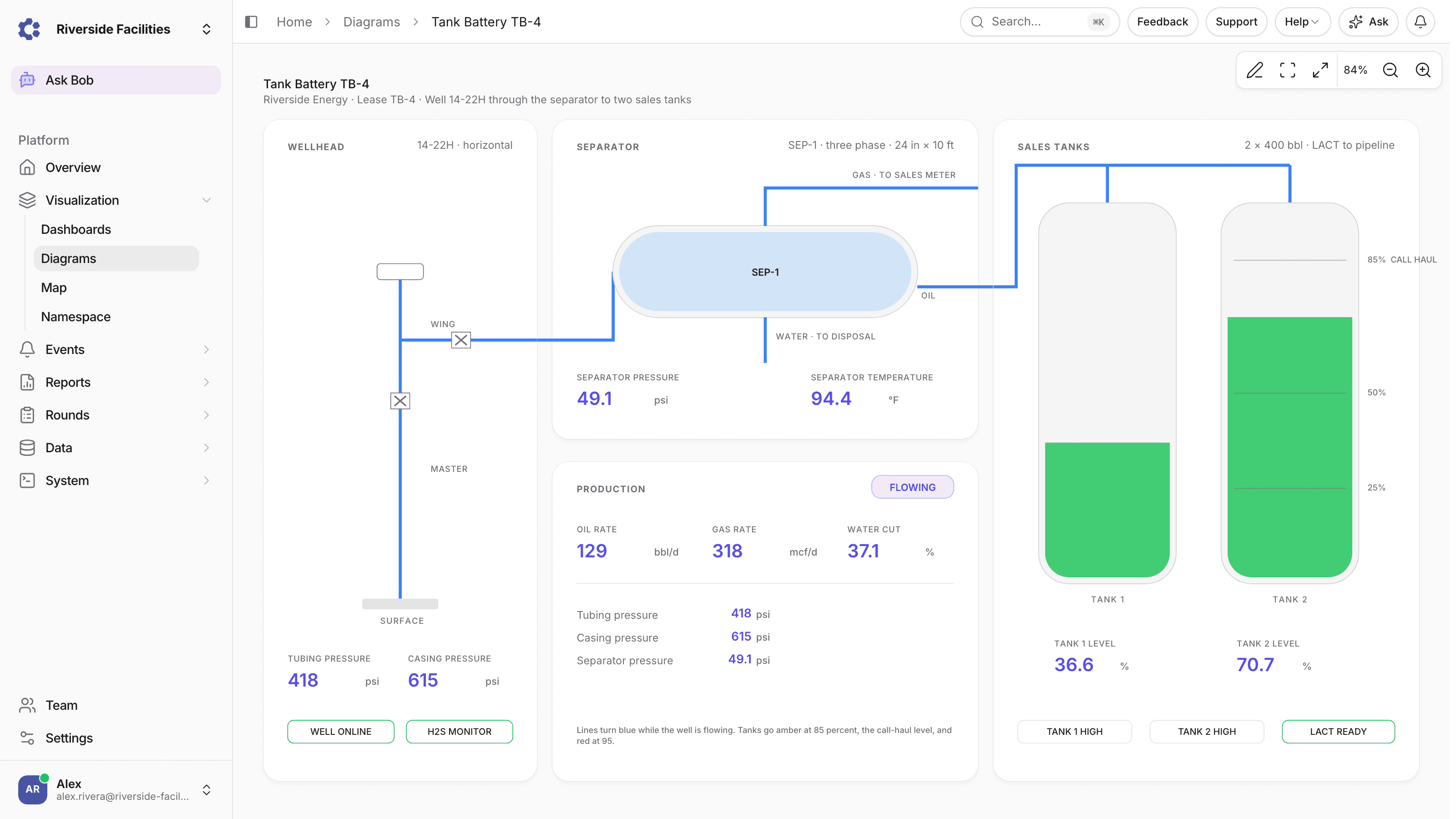
Production assets sit hours apart at the end of a lease road, and the visibility stack most operators run was designed for a plant with a network closet, not a pad with a cell modem.
From single-well pads to gathering systems, the same platform carries the telemetry, the alarms, and the history.
ControlCom Connect delivers oil and gas remote monitoring across wellheads, tank batteries, compressor stations, and pipeline segments from one dashboard. The platform reads the RTUs, flow computers, and PLCs already installed at each site over Modbus, OPC-UA, EtherNet/IP, BACnet, and MQTT, so pressure, temperature, flow, tank level, and run status stream in without replacing a single field device.
At each site, a containerized edge agent collects data locally and syncs it to the cloud. When the cellular or satellite link drops, local storage buffers the unsent readings and forwards them when the connection returns, and threshold alarms keep evaluating at the edge in the meantime. Every well, compressor, and tank is registered in asset management with its own telemetry history and alarm record, which is what makes equipment performance tracking work across a fleet: compare compressor runtime between stations, watch discharge pressure drift, and schedule the maintenance drive before the failure drive.
The same architecture runs other distributed operations: operators of remote generator fleets and utilities running water pumping stations use it for the same reason, sites that are unmanned, far apart, and on unreliable links. For upstream production monitoring that means field-wide rollups by route, district, or asset type. For midstream it means every station on the line reporting into one view instead of one binder per site.
The capabilities that matter when the assets are unmanned, the links are unreliable, and the vendor mix spans decades.
Pre-built connectors for Modbus TCP/RTU, OPC-UA, EtherNet/IP, BACnet, and MQTT read the flow computers, RTUs, and controllers already at the wellhead. No custom drivers, no rip-and-replace, no waiting on an OEM.
The edge agent keeps collecting when the backhaul drops. Local storage buffers unsent readings and forwards them when the cellular or satellite link returns, so trend history stays usable across outages.
Threshold alarms evaluate at the edge and route by severity to mobile push, SMS, and email. The person on call sees the high-pressure alarm on a phone in the truck, not on a screen back at the office.
Roll wells, pads, and stations up by route, district, or field. Multi-site visibility is a default feature, so comparing this month's downtime across a hundred sites does not require exporting a hundred CSVs.
See dashboardsRuntime, cycles, pressures, and temperatures accumulate per asset. Trend views surface the compressor that runs hotter than its twin and the tank that fills faster than its haul schedule assumes.
See equipment performanceThe edge agent is a Docker container making outbound-only connections, with no inbound ports opened on the OT network. Encrypted transport, role-based access, and audit logging are standard.
The outcomes distributed operators measure oil and gas remote monitoring against.
Adjacent pages for operators running distributed, remote assets.
Common questions from production, measurement, and automation teams evaluating ControlCom Connect.
Each site runs the ControlCom Edge Server, a containerized edge agent that collects data locally and syncs it to the cloud. When the cellular or satellite link drops, the agent keeps polling the instrumentation, and local storage buffers the unsent readings; when the connection returns, the buffered data forwards to the platform and the trend history fills in. Threshold alarms and Triggers for protective actions are evaluated at the edge, so a high-pressure alarm or a shutdown action does not depend on the backhaul being up at that moment. The agent also serves Edge HMI panels on the local network, which gives a technician standing at the site a live view even with no internet at all. ControlCom Connect itself is a hosted service; the edge agent is the component that runs inside your site boundary.
Pick a well pad, a compressor station, or the stretch of gathering line nobody likes driving to. We install the edge agent on hardware at the site, connect the instrumentation already there, and you watch live data arrive over the link the site already has. Book a demo to scope it.