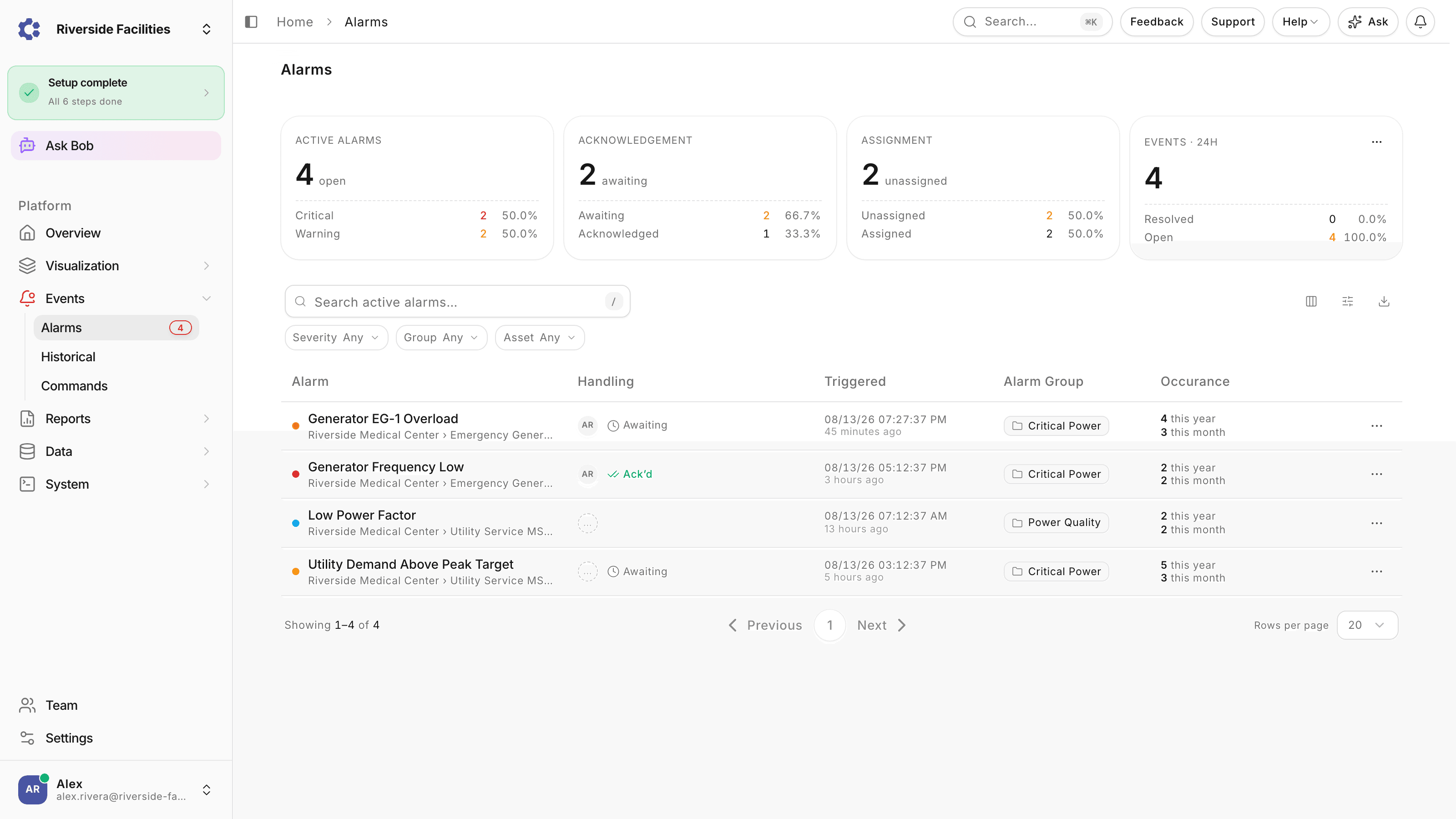
Refrigeration monitoring across every site, one platform
The whole portfolio, at a glance. Real-time temperature alerts, multi-site rollup, energy management, and audit-ready cold chain reporting for grocery, convenience, restaurant, and pharmacy chains. Vendor-neutral and live in days.
Vendor-neutral by designHACCP & CDC VFC readySOC 2 Type IIPilot in weeks
The multi-site reality
Refrigeration is the most expensive thing you can't see
Walk-in failures, door cycles, defrost drift, and refrigerant leaks happen between rounds, and the cost shows up later as shrink, truck rolls, customer complaints, and audit findings. Refrigeration monitoring on legacy controllers and end-of-month reports is no longer enough.
01
01 / Late-detection pain
You find out about a walk-in failure when the produce is already lost
Manual rounds and OEM dataloggers surface refrigeration failures hours late, usually when a store manager opens the cooler the next morning. By then the truck-roll, the shrink write-off, and the customer complaints have already happened.
02
02 / Portfolio-visibility pain
Every site has its own portal, every chain has none
Each refrigeration vendor ships its own cloud, login, and CSV export. Operations teams running fifty or five hundred sites have no portfolio view, just a stack of tabs and a spreadsheet stitched together at end of month.
03
03 / Truck-roll pain
Truck rolls for false alarms eat the maintenance budget
Without real-time context, every nuisance trip becomes a dispatch. A senior tech driving two hours to find a propped-open door is the most expensive way to learn the door was propped open.
04
04 / Compliance pain
Compliance and energy programs live in separate spreadsheets
Audit-ready cold chain logs, ENERGY STAR benchmarking, and refrigerant leak tracking each demand the same underlying data, but every team rebuilds the report by hand because the source-of-truth lives in a different vendor portal.
Use case
Built for retail & restaurant chains
Refrigeration, HVAC, lighting, and energy across hundreds or thousands of sites on one dashboard.
Grocery and convenience chains: refrigeration, HVAC, lighting, and energy across hundreds or thousands of sites on one dashboard. Loss prevention through equipment alerts (walk-in down, door propped open, defrost cycle out of spec). Centralized energy management and refrigerant leak monitoring. Reduce truck rolls with remote diagnostics that tell the tech what to bring before they leave the depot. Chains that run their own processing or commissary plants extend the same platform to food and beverage manufacturing.
Quick-service and full-service restaurants: walk-in cooler monitoring, prep-station temperature logging, and HACCP-ready cold chain reports for every location in the brand. Operators get push and SMS alerts on excursions, store managers get a simple mobile view, and corporate gets portfolio refrigeration uptime in one rollup, no per-store IT project required.
Pharmacy chains and retail cold storage: continuous temperature monitoring for vaccine fridges, medication storage, and cold-chain inventory across every retail pharmacy in the network. Tamper-evident logs that meet CDC VFC documentation requirements, per-asset thresholds, and audit-ready PDF exports the compliance team can deliver on demand.
Temperature alarms across sites, ranked by what is out of range now.
Walk-in, door, and defrost-cycle alerts
HACCP-ready cold chain reports per location
CDC VFC tamper-evident pharmacy logs
Portfolio rollup across the entire fleet
What you get
Features built for multi-site refrigeration monitoring
Six capabilities that turn a passive temperature record into an active loss-prevention, energy, and compliance program.
01
Real-time temperature and door monitoring
Continuous readings from existing probes, dataloggers, and rack controllers on the calibrated sensors you already own. Works with Modbus, BACnet, MQTT, 4-20mA, RTD, thermocouple, and dry-contact door switches.
02
Anomaly and threshold alerts
Per-asset thresholds, severity tiers, and trend-based anomaly events. Catch a slow drift before it crosses an alarm (door cycling too often, compressor degrading, defrost out of spec) so monitoring catches the failure before product is at risk.
Portfolio view across every store, with asset hierarchy by region, site, and unit. Benchmark refrigeration uptime, energy per location, and excursion rates site against site. One platform replaces a stack of vendor portals.
Live energy dashboard, utility-bill ingestion, load-factor reports, and ENERGY STAR-ready benchmarking, generated from the data the platform is already collecting. No second integration, no second login.
05
Mobile push, SMS, and email
Native iOS and Android apps with push notifications and MFA. SMS for critical alarms, push for the on-call rotation, email for daily summaries. Every channel acknowledges back into the same audit trail with user attribution and timestamp.
06
Audit-ready compliance reports
Dashboard-as-PDF for any historical date range, with pre-built templates for HACCP, FDA, CDC VFC, refrigerant leak (EPA Section 608), and ENERGY STAR. Scheduled monthly delivery to the QA distribution list.
Key metrics
What changes when refrigeration monitoring goes real-time
The four numbers operations leadership tracks for refrigeration, surfaced automatically from the data the platform is already collecting.
99.9%+
Refrigeration uptime
Per-site, per-unit uptime tracked automatically. Spot the underperformers and prove the program is working.
12-20%
Energy per location
Typical reduction in energy spend per site once monitoring surfaces scheduling, defrost, and door-cycle waste.
30-50%
Truck-roll reduction
Remote diagnostics cut unnecessary dispatches. Techs see the real cause before they leave the depot.
$10K+/event
Shrinkage avoided
A single caught walk-in failure on dairy, produce, frozen, or pharmacy inventory typically pays back the platform.
Related pages
Explore adjacent industries, the objectives refrigeration monitoring supports, and how the platform holds up.
Common questions from operations, facilities, and compliance leaders evaluating ControlCom Connect.
Critical refrigeration alarms are delivered to on-call phones within seconds of the threshold breach. The edge gateway evaluates thresholds locally at the store, so alarms fire even during a WAN outage, and the cloud fans the event out over SMS, push, and email in parallel rather than one channel at a time. Routing follows alarm groups, so the store manager gets the door-propped warning as a push notification while the walk-in-down critical pages the on-call tech by SMS, and escalation paths re-page when an alarm goes unacknowledged. Trend-based anomaly events fire earlier still, on the door cycling too often or the compressor slowly degrading, before the temperature ever crosses the threshold. Acknowledgement is one tap on the mobile app, with full user attribution and timestamp logged for the audit trail. There is no nightly summary email and no waiting for the next round.
Yes. Multi-site refrigeration is the core use case. Asset hierarchy lets you group every walk-in, prep-station, reach-in, and rack by region, district, site, and unit, and portfolio dashboards benchmark refrigeration uptime, energy per location, excursion rate, and truck-roll volume site against site, so the underperforming stores surface automatically instead of at the end-of-month review. A map view shows the whole portfolio colored by alarm state, with live weather overlays, which reads very differently when twelve stores go amber under the same heat wave versus one store going amber alone. Access is scoped by the same hierarchy: a store manager sees one location, a district manager sees their district, and corporate sees everything, all from the same underlying data. The same portfolio view drops to PDF on a schedule for the operations and ESG distribution lists, with any date range available on demand.
ControlCom Connect implements the controls a regulated pharmacy program expects: continuous temperature logging, tamper-evident audit trail, role-based access with enforced MFA, time-stamped electronic acknowledgement on every alarm, and AES-256 encryption at rest with TLS 1.3 in transit. Pre-built report templates cover CDC VFC, FDA, and 21 CFR Part 11 controls, so the downloadable temperature logs a state immunization program reviewer asks for are a date-range query, not a reconstruction from chart recorders. The record stays gap-free through network incidents because the edge gateway keeps logging locally during an outage and backfills with source timestamps preserved when the connection returns. Every alarm event carries its full history: which severity fired, who was notified on which channel, who acknowledged and when, and none of it can be edited after the fact. We hold a SOC 2 Type II report, available under NDA, and every account signs in with MFA or a magic link.
In almost every case, yes. ControlCom Connect is vendor-neutral by design and reads from any calibrated probe, datalogger, rack controller, or BMS point over Modbus TCP/RTU, BACnet IP/MSTP, OPC UA, MQTT, SNMP, 4-20mA, RTD, thermocouple, and dry contact. That covers the typical chain estate: rack controllers from one refrigeration vendor, walk-in dataloggers from another, door switches wired as dry contacts, and a BMS that predates all of them, often varying store by store because sites were built and remodeled in different years. All of it lands in one platform with one alarm engine, so the monitoring program stops depending on which vendor equipped which store. You keep the refrigeration investment you already made, and there is no per-tag licensing, so monitoring every case and every door instead of a critical shortlist is a coverage decision within the data volume and device allotment of your plan rather than a per-point license purchase. The OEM portals can stay or go; the data no longer lives only there.
They do, because acknowledgement is one tap and the alarm tells them what to bring. Native iOS and Android apps ship with push notifications, MFA, and a simple per-site view designed for non-technical staff, so a store manager can check the walk-in from the sales floor without training. Access follows the asset hierarchy: store managers see only their location, regional managers see their district, and corporate sees the portfolio, all from the same app. The alarm that reaches the on-call tech carries diagnostic context, the temperature trend, the door state, the compressor behavior, so they can tell a propped door from a failing compressor before leaving the depot, decide what parts to bring, or resolve it from the parking lot instead of after driving back to a workstation. That context is where the 30-50% reduction in truck rolls comes from: fewer dispatches, and the ones that happen arrive prepared.
A single-store or single-region pilot is typically live within two to three weeks. Week one is discovery: we inventory the probes, rack controllers, dataloggers, and protocols already in the stores, plus the alarm and escalation workflows your operations team actually wants, who gets paged for a walk-in-down at 2am, and who just needs the morning summary. Week two is the edge install and configuration: thresholds per asset, severity tiers, the store and district dashboards, and the report templates. From there the platform runs in parallel with whatever you have today, OEM portals, dataloggers, or manual rounds, so you evaluate refrigeration monitoring on real alarms and real product without any cutover risk. Most chains pilot on three to five stores in one region, check the alert quality and the truck-roll numbers against the old way, then expand to the rest of the fleet on their own schedule.
Get started
Pilot refrigeration monitoring on one region
Pick three to five stores. We onboard your existing rack controllers and sensors, configure the alarms, rollup, and reports your operations team needs, and run alongside your current system for ninety days. No rip-and-replace. No cutover risk. Expand to the rest of the fleet on your schedule.